The 14 allergens your menu must show: an EU guide for restaurants
Since 2014, restaurants, cafés and bakeries in the European Union must tell guests about 14 allergens. Find out what they are, where they hide in everyday dishes and how to show them on your menu without fuss.
Since 13 December 2014, allergen information has also been mandatory for food served unpackaged — which includes restaurants, cafés, bakeries, bars and takeaways. For someone with a food allergy, that information is not a detail: it is what lets them eat out safely.
This guide covers the 14 allergens, where they usually turn up, the most common mistakes and how to show everything clearly on your menu.
What the law says
The rule comes from Regulation (EU) No 1169/2011 on the provision of food information to consumers. Its Annex II lists 14 substances that cause allergies or intolerances and must be declared whenever they are present in a food — including non-prepacked food such as a restaurant's dishes.
Each member state decides how that information is provided for non-prepacked food. In practice, the safest approach is for the information to be in writing, easy to consult and available before the guest orders.
The 14 allergens
Cereals containing gluten — wheat, rye, barley, oats, spelt, kamut and products made from them.
Crustaceans — prawns, lobster, crab, langoustine.
Eggs — including mayonnaise, fresh pasta and many desserts.
Fish — also in fish sauces and stocks.
Peanuts — and peanut oil or butter.
Soybeans — soy sauce, tofu, soy lecithin.
Milk — including lactose, butter, cream and cheese.
Nuts — almonds, hazelnuts, walnuts, cashews, pecans, Brazil nuts, pistachios and macadamia nuts.
Celery — including celeriac and stocks made with it.
Mustard — in sauces, dressings and marinades.
Sesame seeds — also in tahini and bread.
Sulphur dioxide and sulphites — above 10 mg/kg or 10 mg/l; common in wine, vinegar and dried fruit.
The obvious allergens are rarely the problem. The ones that slip through are almost always in the details:
Sauces, stocks and seasonings — shellfish stock in the rice, mustard in the dressing, celery in the base of a stew.
Shared frying oil — if you fry fish and chips in the same oil, the chips are no longer safe for someone allergic to fish.
Drinks — sulphites in wine and gluten in beer count too.
Desserts and pastries — eggs, milk, gluten and nuts are in almost everything.
New suppliers or recipes — the new bread may contain sesame; a new brand of cream may have different ingredients.
How to show allergens on your menu
Dish by dish. The clearest way is to list allergens next to each dish, not in a separate document guests have to ask for.
With a legend. If you use codes or icons, guests must be able to understand them — on the menu itself.
In the guest's language. On a translated menu, the allergens need translating too.
Always up to date. When a recipe changes, the menu has to change the same day.
With a trained team. Even with the right menu, staff should know how to answer and what to do when a guest mentions an allergy.
How Menuyo helps
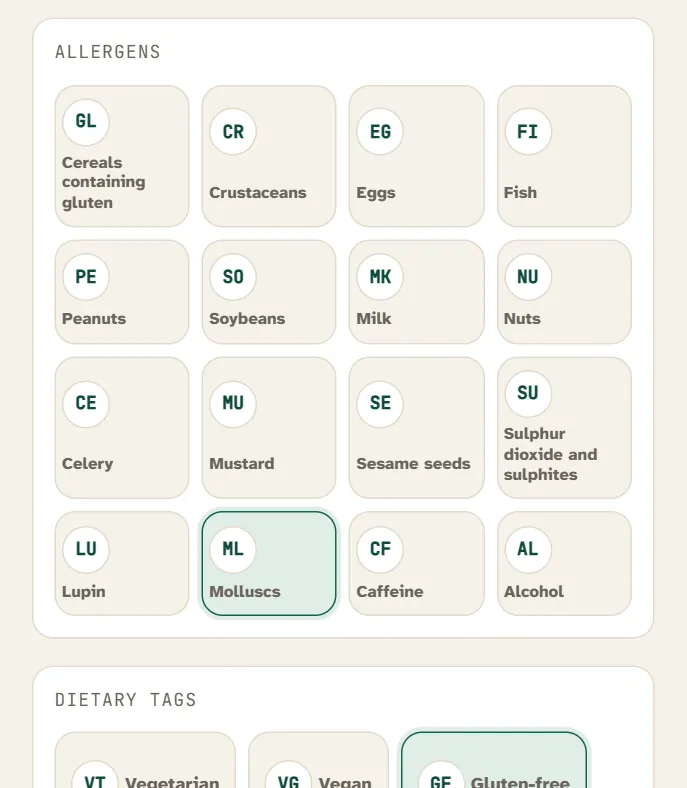
In Menuyo, every dish has a grid with the 14 allergens. You tick them with one tap — and you can add extra information such as caffeine or alcohol, plus tags like vegetarian, vegan, gluten-free or spicy.
The 14 mandatory allergens, plus caffeine and alcohol, ticked dish by dish.
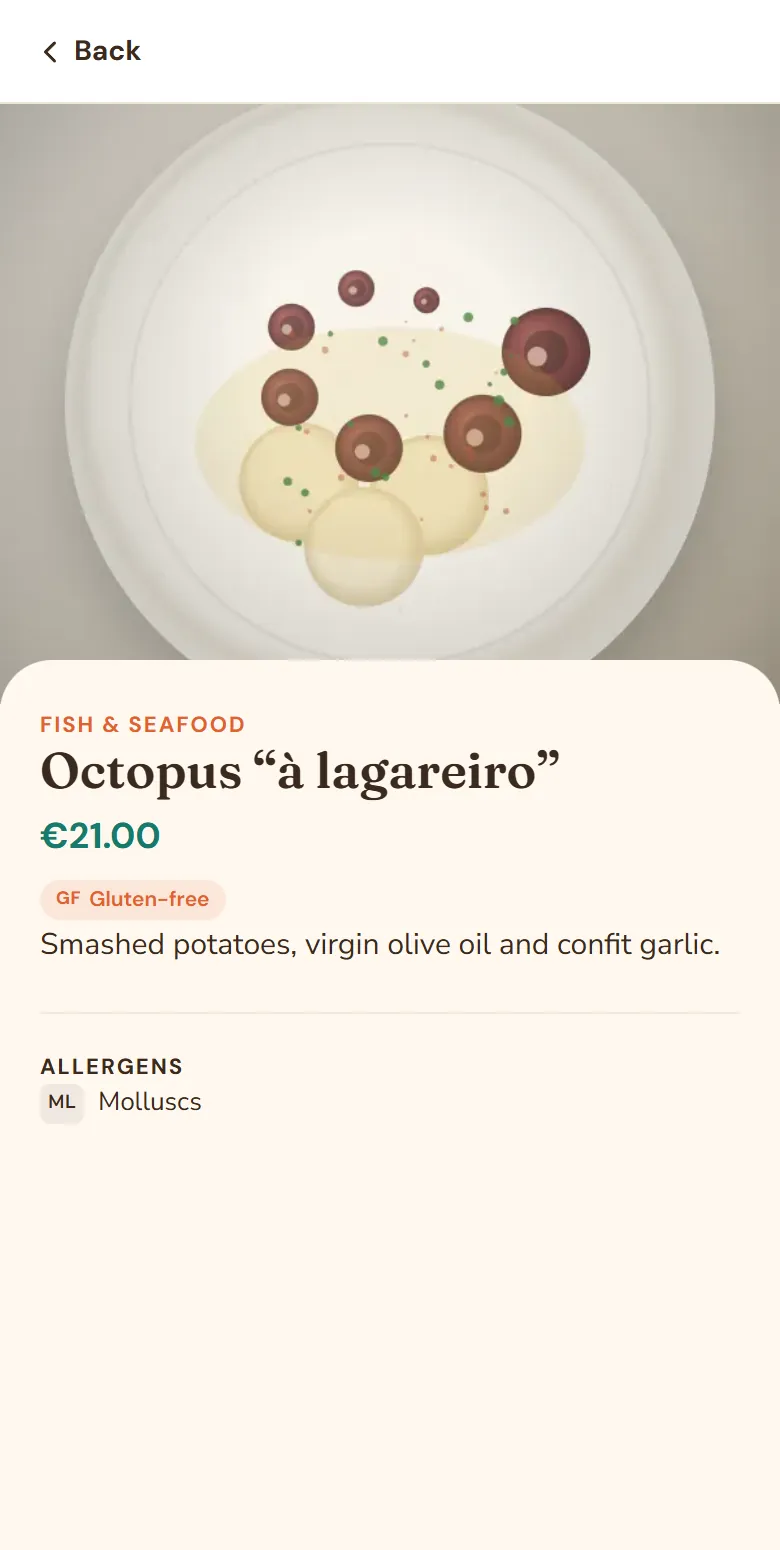
On the menu, guests see the codes next to each dish and, when they open it, the full list with names spelled out — in the language they chose. When a recipe changes, you update the dish and the information changes instantly, on the same QR code.
In the dish details, guests see allergens spelled out in full.
If you also have a paper menu, the PDF created in Print menu can include the allergen legend, so the printed version says the same as the digital one.
Frequently asked questions
Can I just say "ask your server about allergens"?
It depends on national rules, but written information available before ordering is always the safest choice — for guests and for your business. Check with your national authority what applies to you.
What about "may contain traces of…"?
Precautionary statements about possible cross-contamination are voluntary and do not replace the list of allergens that are present. Use them carefully: warning that everything "may contain everything" helps nobody choose.
Can I label a dish "gluten-free"?
The claim "gluten-free" has its own EU rules (Commission Implementing Regulation (EU) No 828/2014): the food must contain no more than 20 mg/kg of gluten. If you cannot guarantee that — because of cross-contamination in the kitchen, for example — it is better not to use the claim.
Start today
With Menuyo, allergens sit where guests look for them: next to each dish. Try it free for 15 days, no card needed, and see in our step-by-step guide how to build your whole menu.